Christian Soldiers of Rome
The hymn, onward Christian soldiers has been one of my favorites for as long as I can remember. I would march around the couch with my cousins when we’d sing the hymn at Family Reunions. The rhythmic melody and grand chords conjured up images of marching legions and waving banners. It made me want to charge out the door into the chill night air. If I could just lead the ring of marching cousins out into the streets of Farmington Ut., I was sure that we’d find ourselves in the thick of a battle raging between Michael and Lucifer. Though such childish imaginations have long since faded away, the brave harmonies conveyed in the song still inspire action and unearth a feeling of invincibility. It’s not hard to see the connection to the invincible legions of ancient Rome.
The first verse and the chorus of the song paint the picture that my 6-year old mind saw in such vivid detail. The lines “Forward into battle, See his banners go!” and “With the cross of Jesus Going on before” point out the central imagery of the setting(Sabine 1). Yes, it’s a war but it’s not a chaotic jumble of chariots and trojan horses. We’re following banners. The cross of Jesus in particular is the central banner around which we rally and find our instructions.
Even before Constantine’s men marched under the Chi Ro, banners were an important part of Roman military strategy and culture. They were used to signal attack, retreat and various formations (Mark 13). As long as a banner stood, the war was not lost. In both cases, the banner represents loyalty to a greater cause. Polybius records that “For many Romans have voluntarily engaged in single combat in order to decide a battle, not a few have faced certain death, some in war to save the lives of the rest, and others in peace to save the republic” (Polybius 6.54)
For Christians following the cross and Romans following S.P.Q.R, the outward intent is the same. Protect the greater cause. The motivation, however, is probably different. The anthem states “All glory laude and Honor Unto Christ, the King”(Sabine 4). Contrastingly, Polybius noted that “the most important result is that young men are thus inspired to endure every suffering for public welfare in the hope of winning the glory that attends on brave men” (Polybius 6.54).
Another similarity between Roman principles and those espoused by the Hymn is the call for outsiders to Join under the banner. “Join our happy throng. Blend with ours your voices in the triumph song”(Sabine 4). The Romans had assimilation embedded in their founding mythology. When Romulus realized that Rome was doomed without women, he invited the Sabines to join their cause. Obviously, the Romans weren’t exactly doing street contacting, but the spirit of the principle is captured by Livy. “Nevertheless the daughters should be wedded and become co-partners in all the possessions of the Romans, in their citizenship and, dearest privilege of all to the human race, in their children” (Livy 1.9). Roman attitudes towards assimilation remained open, (though limited) for the duration of the roman empire. The example of Paul of Tarshish, a Jew and Roman citizen stands out in this context.
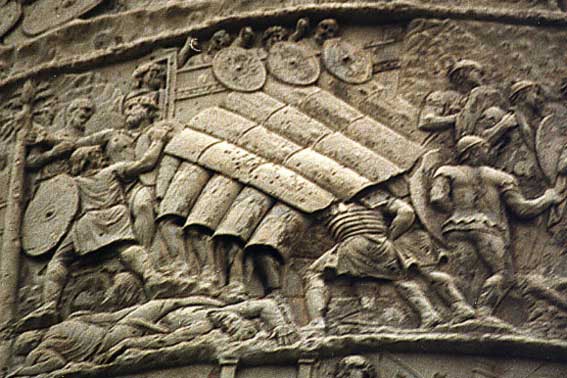
The openness towards newcomers, in both traditions, was tempered by a bulwark of unity. The spirit of the compromise might be captured in the familiar Latter-day Saint saying “come as you are, but don’t expect to stay that way” The song states “we are not divided; all one body we”(Sabine 3). The Romans also understood the importance of unity. The principle was deeply engrained right up into the military tactics they employed across the empire. The testudo was a military formation that utilized individual soldiers’ armaments to create a turtle-like shell of armor, which allowed the Romans to advance up to the city walls amidst storms of arrows and stones. The tactic was a successful military ploy and a symbol of Roman unity, the Trajan column testifies to its lasting symbolism to Romans.


Perhaps the starkest contrast between Christian soldiers and Roman soldiers is the way they are “one”. Christian soldier are “One in charity”. While the Romans deserve laude and honor for bringing law, order, and peace to much of the ancient world, they could never really claim charity. That is, loving one’s enemies and doing good to those that abuse you, particularly in the realm of forgiveness. Seutonius records “[Augustus] took vengeance on many, meeting all attempts to beg for pardon or to make excuses with the one reply, ‘you must die.’”( Suetonius, Divus Augustus, 13).
Christian soldiers have no doubt of the eventual victor. The invincibility the song portrays is best expressed in the second verse “At the sign of triumph Satan's host doth flee; On, then, Christian soldiers, On to victory”(Sabine 2). Latter day saint language mirrors this idea, Christ will win the war, we only must decide to fight with Him. Similarly, from the earliest days of the Punic wars, Romans were confident in their eventual ability to win. “Consequently even if they happen to be worsted at the outset, the Romans redeem defeat by final success (Polybius 6.52)”--
The final similarity between Christian soldiers and Roman soldiers I’ll mention here is an emphasis on tradition. The hymn records “Brothers, we are treading Where the Saints have trod”. Augustus was so concerned with treading where the saints had trod that he commissioned Virgil to write an epic that proved Romans were treading in the Trojan tradition and that Aeneas was the son of a god. Augustus himself claimed the epic hero as an ancestor. Julius became a god by Augustus’s decree and the people's affirmation(Suetonius, Divas lulius, 88). Imperial Rome referred to its latest ruler as Caesar. All this in the spirit of treading where the saints had trod.
There’s no doubt that Christian soldiers and Roman soldiers share much in common. It is well said that Rome was fertile soil for the seeds of Christianity.
“Some fell upon stony places… 6 And when the sun was up, they were scorched… 7 And some fell among thorns; and the thorns sprung up, and choked them: 8 But other fell into good ground, and brought forth fruit, some an hundredfold, some sixtyfold, some thirtyfold” (Mathew 13)
Still, we see some very important differences. Perhaps we can learn something about spreading the gospel to different countries and cultures by appreciating more fully, the first wholesale converts to Christianity.
Polybius. The Histories of
Polybius. Bloomington :Indiana
University Press, 1962.
Testudo –
Horizontal & Birds-Eye Perspective, Trajan’s Column, cited at: http://www.bueker-gmbh.de/pics/u/schildkroete.jpg, accessed on 30th 2016.
Suetonius, De Vita Caesarum, Divus Augustus, 13, 15
Suetonius, De Vita Caesarum, Divus lulius 88
Mark, Joshua
J. “Roman Standard.” Ancient History Encyclopedia, Ancient History Encyclopedia, 17 Nov. 2019, https://www.ancient.eu/Roman_Standard/.
Livy. The Early History of Rome. Books I-V of The History of Rome from Its
Foundation. [Harmondsworth, Eng.]
:Penguin, 1971
Sabine,
Bauring-Gould. “Onward, Christian Soldiers.” Churchofjesuschrist.org, The Church of Jesus Christ of Latter-Day Saints,
https://www.churchofjesuschrist.org/music/library/hymns/onward-christian-soldiers?lang=eng&_r=1.


What a creative essay! I really enjoyed the personal connection you made to “Onward Christian Soldiers,” describing how, “The rhythmic melody and grand chords conjured up images of marching legions and waving banners. It made me want to charge out the door into the chill night air.” By describing the song as something that spurs feelings of “invincibility” and thereby appeals to the Romans, you helped me understand the connection between the Romans and the Christians on a relatable, personal level. I also enjoyed reading about the relationship between Testudo military tactics and unity. I also wrote about unity in my essay, but I did not think to discuss the military formations as an example of Roman’s desire for a unified military force. Thanks for sharing a fresh perspective.
ReplyDeleteYou did a great job in this paper outlining how both Romans and Christians had a greater cause in mind, but that the motivation is different. I wrote extensively about this in my essay as well. The Christians had a more spiritual, holy goal in mind. In contrast, the Romans were all about glory and violence. I also liked your comments on how both cultures were open to newcomers, this was an important trait I hadn’t quite thought about.
ReplyDelete